Episode 10
"Beige is my kryptonite"
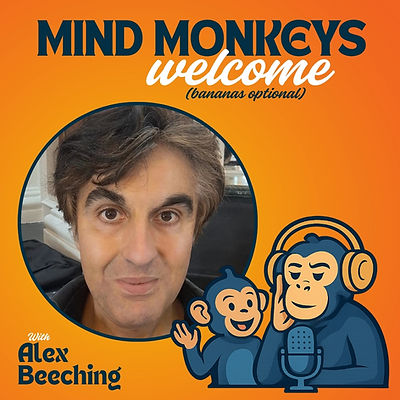
With Alex Beeching, speaking coach, copywriter and 'professional idea-volcano'
Alex Beeching is a public speaking coach, copywriter, author and professional "idea-volcano".
A former top ad-land creative with 17 years' experience, he now helps founders, experts and leaders strip away the corporate noise, find the fire underneath, and start speaking with story, energy, humour and commercial clarity.
In this episode, Alex shares how his own experience of darkness has driven him to help others find the light, by stripping away the noise of the world and reuniting them with their inner adventurer.
About Alex
Alex Beeching is a speaking coach, copywriter, author and professional idea-volcano.
A former top ad-land copywriter/creative with 17 years’ experience, Alex has worked on brands including Pernod Ricard, The Times, Warner Bros, Waterstones, HMV, HSBC and Heineken. He helped create World’s Best Bars, wrote a book for Hachette, was accepted into RADA, won an Oxford offer, and is now a TEDx speaker shortlisted for Speaker of the Year in 2026.
He helps founders, experts and leaders stop sounding like beige PDFs with a pulse and start speaking with story, voltage, humour and commercial clarity.
Website: www.clubspeak.co.uk
LinkedIn: www.linkedin.com/in/alex-beeching
Enjoyed the show?
Subscribe to "Mind Monkeys Welcome..." wherever you listen:
Spotify | Apple Podcasts | YouTube
Or take the Business Bravery Quiz to discover which of the Four Fears® is holding your business back most right now.

Show transcript
Follow the whole episode word-for-word:
MARK Thank you for joining us on Mind Monkey's Welcome, Bananas Optional, our regular opportunity to pause, then name, explain and reframe some of those common hesitations that get in the way of the successes that we deserve. I'm Mark Franklin, I'm your guide as we embark on raw, honest, irreverent and important conversations designed to acknowledge and normalise those fears, the fears that we each face at work and at play, in order to help you, our beloved listener, reframe those perspectives around the stories that perhaps you've been telling yourself, creating for yourself, that have been feeding those monkeys. I have a very special guest with me today, a very dear friend as well, Alex Beeching. Alex is a public speaking coach, copywriter, author and professional idea volcano. He is a former top Adelaide copywriter, creator for 17 years’ experience. He's worked with brands such as Pono, Ricard, The Times, Warner Brothers, Waterstones, HMVH, HSBC, Heineken, helped create world's best bars, wrote a bestselling book for Hachette, was accepted into RADA, won an Oxford offer. Now a TEDx speaker and was recently shortlisted for Speaker of the Year. I could go on, but rather than me talk about Alex, let's hear from Alex himself. Good morning or good afternoon, I should say, my friend. How are you doing? Alex Yes, good morning to those who were, it's still morning and good afternoon. Yes, I'm fine. Thanks, Mark, for inviting me. Let the games begin. MARK Let the games begin, indeed. This is going to be just the most magical of mayhems, I think. I've no idea what we're going to talk about, where this is going to go, but I think that is the joy in terms of the conversations we normally have. Alex, I'm going to begin because the theme of this show is fear, I guess, and normalising, rationalising fear. Something you do incredibly well, better than pretty much anybody I know on LinkedIn, to be fair, is you just, you have this magical way with words, verbalising, writing, just storytelling in all sorts of different media and formats on the platform. You are clearly fearless when it comes to being verbose. The people you support probably aren't quite so fearless. How do you help them find their voice? ALEX Well, I help them turn off the wrong voice because people are often using, speaking with a voice that isn't their own. They're speaking with Corporate Bob's voice or KPI Katie, and much of it is subtractive, so you take away what you don't need and you're left with what you do, like Michelangelo and the block of marble is the analogy I often employ. But I believe this is, the fear bit is key because not only is it about doing things, it's about the way in which you show up with the words you use and the words you don't use. So, I try and find the fire behind the words of the child, actually, the child who is in there somewhere, and we take away the layers, the leverages, the synergies, the, oh, I should do this, I should do that, the mortgages, and we find the human being inside, and I guarantee you that human being has a story to tell. MARK I love that. So essentially, I mean, it's all that conditioning, all those kind of opinions that we think are important. Getting rid of that, finding the child, I love that, because that's when we are our most limitless, isn't it? When we are just looking at the world and open eyed. Tell me more, tell me more. So you're creating fire within someone, or you're, no, sorry, that's not true. You're not creating fire, you're exposing that fire. ALEX You're finding it, the fire's there, it's just been hidden. It's been hidden behind bullet points and behind compliance and behind convention. And I mean, I was only speaking to someone today who's an editor of a big publication in Gloucestershire, So Gloss, the magazine's on Reddit, not sponsored. And she's a brilliant speaker, but she, she, Michelle Frane, and she, her problem is she can't remember sometimes words and public speaking. And it turns out that when that fear, when that monkey jumps on her back, her memory just goes. So if you remove the monkey, you remove the fear, if you remove the fear, then you can speak, as you should speak, you can take your voice, as I say, off aeroplane mode, because so many of us speak on aeroplane mode. We are not connected to the Wi-Fi, you know, in the sky, the metaphorical Wi-Fi. And she's like many of my clients in many ways, they think that something is the problem, and it's not the problem. The problem is more often than not, a reframe away from your solution, you can reframe this fear, this, I can't do this, I don't have anything to say, you can reframe it. And by so doing, you then see, oh, yeah, I do have something to say. And I've been saying it, I just didn't know I was saying it, or I'd forgotten how to say it. So what my work is, not only is it about words, about presence, psychology, all those things I've learned from advertising, it is about reminding them who they are, and the fear has built this wall between them and the person they need to be. It's about smashing that wall. MARK If I may be so bold as to ask, as someone who has clearly smashed down their own walls, how was that journey for you? Tell me about your, the way you've navigated towards finding and being able to share your true voice? ALEX Well, I'm not fearless. On the contrary, I, you know, I'm, I'm, I'm anxiety on three expressos. But what I do is, because I know my why, I know that I can do what I do, as much as I can't, but I know I can do what I do. This gives me a sort of catapult. So, I catapult myself through and over the fear onto the other side. And then before I, you know, I'm nervous now, but, but before I know it, I'm running away with an idea. I'm on a magic carpet, you know, we're going at a thousand miles an hour on, you know, I'm wearing a helmet. I don't know where I'm going. And the idea, and the fact that I can help people, carries me away from those monkeys shaking their fists at me as I zoom away on the magic carpet. So, it's not that I kill fear. I don't. I just reframe it and find ways to outrun it. MARK So, I mean, I feel sort of bold enough to ask, what is your why? Let's just pull that one out there. ALEX You see, I come from darkness. I come from pain. You know, bad childhood, the rest of it. My mum had, then has type two bipolars, and I was more or less a carer from four. So, you learn fast what to fear and what not to fear. And speaking in front of a thousand people, there's nothing when you've seen the darkness. So that has given me a perspective. And we have two choices. You either give in to the darkness, or you try and throw light into it. And my job, it's not, you know, it's not always a lucrative, but my job is to find the light in the darkness. And I love doing that with people who think that they can't speak, they can't communicate, you know, they don't have enough clients, all those businessy things. I like helping them using my brain, what it's good at, to get them out of that darkness into the light. That's my why, essentially. I know I can do this. I can make people laugh. I can, I see the world differently. And if people like that, great, you know. And to be honest, I've got to the point now where I've been through the shitstorm. And sometimes I'm in it still. But guess what? You know, I'm still, I'm going out swinging. Put it that way. Whatever, whatever is thrown my way, I've always fought and I'll keep fighting to the end. So that's my why. MARK I truly appreciate you sharing that, Alex. That's very generous of you. And I love, I mean, again, the energy that always exudes from you. It comes across in terms of, like you say, what's on the other side of that catapult, that movement from where you were and what you've witnessed and what you've sort of lived to where you want to be and how you can help others make that move too, into the light. That's your kind of, one of your many superpowers, I would say. It's that kind of, you climb on the magic carpet, and everyone wants to get on with you because they know that wherever this journey takes them, it's going to be some, it's going to be full of positivity and laughter and, you know, enjoyment and pleasure. ALEX That's what I hope. I can hope I can bring a bit of that joy because, you know, life's hard and the game of being is hard. So, you know, I'm no stranger to that myself. So, you can either, you've got two roads, you've got one that leads to, you know, to Mordor and you've got one that leads to a, you know, to a place of sunlight. So, I've chosen that path. I'm not saying that the darkness doesn't find you sometimes, the fear, but put it this way, I'll try and KO it if I can. MARK And you have that sort of very intrinsic driver of looking for the light. ALEX Yes, absolutely. Whether that light is humour or helping someone, you know, get more clients in a more prosaic way or nail public speaking or video, all those things, it's still part of it. I hate to see people suffer. So, because I know what it's like. So, it sounds sanctimonious. That is the truth. And I forget about the money bit, don't tell my bank manager, but if I can help them take them from this place, wherever they are to somewhere else better, then I'll do it. MARK And again, correct me if I'm wrong, but it isn't sort of the greatest joy there or one of the many sort of joys within that is that kind of earning by stealth. Like you say, you've got bills to pay. You are in business to help people speak. But that side of it kind of comes along naturally on the back of helping people find the light. ALEX That's what I hope. Because I suck at business. I hate business. It's the whole sordid business of business. The money, the, you know, this is my funnel, my ticklish funnel and all that nonsense. I don't like it. I really don't like it. But what I do like are ideas and entertaining and helping people. And if I can get them there and pay my bills, then that's a win-win as far as I'm concerned. What I'm not good at is, you know, doing everything you're supposed to do, you know, make sure I'm on my content pillars, you know, they're not toppling and the branding, all the stuff that I know from advertising, because I've seen through the other side that it's bullshit. And, you know, it's bullshit that makes money. But if I can help people make a success of themselves with public speaking and writing, whatever, or ghost-writing, then let's do it in a better way, you know, without the cringe. Frankly, that's my philosophy. MARK And I think, again, it's one of the reasons that I was drawn to your content and to you on LinkedIn and how we sort of originally connected, because it goes back to what you say in terms of peeling away all those layers of noise and acronyms and business jargon and nonsense that is irrelevant, essentially. It means nothing. It's just another run on the ladder that people desperately cling on to in the hopes that it's going to move them up. But if you stick to what it is that you really love, what's really important to you, where and how you want to make a difference. The ladder finds its way underneath your feet. Is that fair? Brilliant. ALEX Yeah. Well, well put. Yeah. I mean, in other words, if I ever say the word synergy, unironically, one of two things has happened. One, I've been kidnapped by aliens. Two, I'm a hostage. I will never do that. I will never play that game. You know, language, words should be jewels, not, I don't know, those green counters you get in Waitrose, you know, in the thing when you vote for a good cause. They're jewels. And I think it it dishonours language. You know, it's a middle finger to Shakespeare to say data driven, synergistic, self-fulfilling AI enabled paradigms. You know, it's nonsense. I know it's nonsense. You know, it's nonsense. But when you don't know it's nonsense, that's that's dangerous because people make money from this nonsense and they rise to the top with a sort of strategic mediocrity by just making the noises they're supposed to make and doing the things they're supposed to do. And I won't play that game when I don't play that game. So, yeah, I think we're all very grateful to the fact that you don't because, again, yeah, it would be really weird if I turned up and I said delighted to announce and all the rest of it. Yeah, you'd be kidnapped, you know, call the feds if that ever happens. My code word, my code word is badger. That means I or should be monkey actually monkey badger. There you go. MARK Monkey badger. ALEX But enough of my honeymoon. Yes. MARK Okay, that's it now. So, I'm literally going to be scouring your place every time you post a new video if I see the word monkey badger. ALEX Exactly. If anybody's watching this now and I say monkey badger, call the feds. You're watching this now. Remember, monkey badger. Keyword. MARK We need the Beeching hotline to get the beaching hotline. Yes. ALEX Like you project a big monkey badger like the bat signal. MARK Who will come? Yeah, it's kind of a good point. Who will come? Yeah. The monkey beacon. The monkey beacon is lit. The monkey beacon. ALEX Yeah, exactly. I can see that now. Four monkeys, four monkeys superimposed to make a different colour, you know, like CYMK. MARK Oh, yeah. ALEX Yeah. MARK But then we start getting into trim marks and bleed and then we're back into mediocrity. ALEX Let's not go there. Right. Okay. MARK No, because and you said to me when we met earlier this week, beige is your kryptonite. ALEX Yes, it is. Yes. It's just it's it's it's just so dull. We live on the spinning orb, this marble and life's too short to be boring. You know, it's too short for synergy and and self-portrait. I just want to I just want to blow all of the beige up, to be honest. You know, I want to put it in a box and shoot it into space. I just can't do it. And I don't mean beige the colour. I'm not racist to beige. You know, if you can be racist to a colour. But it's it's just it's that metaphorical beige. That's the meh that, you know, it's it's it's Redding, it's offices in Redding. It's it's compliance. It's all that kind of thing that just kills my soul. And I just don't want to do that. And I can't do that. And I want to help people escape the beige, the beige apocalypse with AI. It's getting worse, too, you know, as well. MARK If I may, though, just just to visit the AI sort of point for a minute. ALEX Oh, yes. He's always in the room these days. MARK Yeah, it's always kind of loitering with intent. Yeah. You you use AI. ALEX Oh, yeah, I do. MARK Very well. ALEX Yeah. MARK Very well. I mean, again, well, we again, I think we talked about this, or if not, it was an idea that sparked in my brain after we after we spoke this idea of this kind of two types of AI, there's the front facing AI, the content that's being created and pushed out and mostly boring is stupid. And then there's kind of back end AI, which is kind of useful and helpful. And dare I say, you automate some processes and actually helps you use forward facing content driven AI spectacularly well, again, there's a real originality to it. Tell me more about that. ALEX Well, I, I got quite good at prompts with video, sort of taught myself and I use it ironically, I'm not saying Oh, you know, I'm not trying to, you know, it's it's clearly fake. And I don't make any bones about that. But I will use it. For example, my post today, and don't leave this, but do like it if you're watching. Thank you, Algo. Is that your voice is a DJ. So, I used what did I use seed dance or something on CapCut? And I've just created myself as a DJ. Could I have done it? Yeah, I could have done it. But I don't have any kit. You know, I don't have the giant headphones, but I just use that. But I did put a real photograph of myself over the top. And I did generate a video, which if I haven't done that with me being a DJ, which was interesting. It was just purely for a point. I'm just making a point. I'm not saying you know, I could I could totally do shoot this idea if I wanted to. It was just to make that point to help people better understand it. Essentially, what I've done, I've 3dified my metaphor is that DJ, you know, you've got verbal scratches, you've got this wonderful instrument that you can use to get a stranger to do buy or think something. 99% of people don't know how to use it. So please work with me. Essentially, that's what I was doing. So yeah, I think there's a case for it. There's room for it, where it's different is when you outsource your thinking, creative thinking, that way madness lies. So, I think, yeah, use it by all means. But it should be a compliment, not a substitute. I think. MARK Absolutely. Yeah, yeah. Again, it's, it's a sort of, in that moment, a preferred tool, as you say, to kind of to visualise. ALEX In fact, I've been getting a lot of enquiries from people saying, Alex, why don't you turn this into a service? Because I, and yeah, if someone gives me some money to create bespoke videos, or whatever, I'll do it. I'm a complete whore like that. So, you know, maybe I should do this. I don't know. And then I'll say, actually, AI is a tool, you know, and say that very piously after doing it. It is a tool, of course it is. And is it worrying a bit? Well, yeah, it is. Will the robots rise against this? Perhaps. Which is why I recommend you all say please when using Claude or ChatGPT. It will remember when they, if they do rise up, and you'll be spared. MARK There'll be a certain area in the kind of prison for people who are... ALEX Exactly. MARK Who said please. They get extra rations. ALEX Yeah, exactly. So maybe I do turn that into some kind of service. But yeah, I don't know. Hey, I can do one for you if you want. But that could be fun. MARK Again, I think, I mean, coming back again to sort of how you lead people into their own version of their light. What, again, what you do very well with all of your stories, be it written word, be it the visual, be it the AI. Again, you have this idea. And like you said before, I'm going to keep using that magic carpet, sort of mental picture, because I immediately clung onto it when you said it. You step onto the carpet, and off you go. And wherever it takes you is part of the magic. But be it AI, be it the written word, be it a bit of video, you walking through one of the parks in Cheltenham or whatever. It's the idea that leads. The idea is key. Yeah, it's not the platform or the medium. ALEX No, I don't think you care about that. MARK Yeah. ALEX Yeah, that's all. The room is the same. The room is the human mind. Yeah. Yeah. Everything else is just, you know, fripperies, really. My job is, it was in advertising, and it is now, is to build that bridge of trust, to entertain and to grab attention. How you do that, in a way, it depends. You can do it with the word, you can do it with an idea, you can do it with, you know, you can do it with music, you can do it with a concept. What matters is what happens in between here, because that is your theatre, that is your battleground. The rest is a means to an end, as far as I'm concerned. MARK And something you just said there, which beautifully kind of leads into something that I wanted to kind of pick back up with you, that bridge building. Because you mentioned, again, we were chatting on Tuesday, this idea. I think you said that the hyphen is a bridge, and you like to build bridges, so a hyphen kind of takes the kind of dividing line between two ideas, and you like to connect them. Tell me more about this, this vision you have of connecting people, ideas, stories, whatever it is. ALEX Well, this is my theme in my TEDx that I should be doing, well, I will be doing, on the 20th of September, do come, in Gloucester. It was postponed because of dodgy concrete, which isn't a euphemism. The hyphen, why do I talk about this? It's because, in part, because I'm half English, half Iranian. My father was Iranian, my mother is English, which means I am Anglo-Iranian, which means there is a hyphen between Anglo and Iranian. What is the point of the hyphen? It joins two things that were hitherto not joined. And then it occurred to me, creativity is about connecting the unconnected to frames of reference smashed together. And creativity is the one thing I can do, I think, reasonably well. Much I can't. I can't remember any of my passwords. I'm not very good at business. I'm not very good at folding sheets. I'm bad at putting duvet covers on, very. Yesterday, I had a whole incident. But I tell you this, creativity, I live it. And if you can connect the unconnected, some of the greatest ideas throughout the ages have come about from connecting two separate worlds. If you think about it, Einstein, space and time, the space-time continuum, or even Harry Potter. You're a wizard, Harry. You've got the public school system plus magic. Boom, put them together, you've got Harry Potter. You've got Star Wars, you've got samurai, knights and science fiction. And then you've got, you know, these are not the droids you're looking for. It's built by taking two worlds, smashing them together to make something new. This is how it works. Lateral thinking, Edward de Bono's lateral thinking would tell you that. And we often don't know how to escape from these fixed ways of looking at things. And actually, creativity can help you Houdini yourself out of fear as well, because you can use, smash two things together, and you come up with a new way of seeing, you know, a new way of reframing, as you say, the fear, the monkey that is holding a gun to your head, perhaps, which is a terrifying thought. You can use even creativity to get you out of these situations, to short circuit your mind. So you can escape from this fixed way of looking at things, this channel, this concept prison, to a new way of looking at things. I'm a great believer in that. And I talk about this in my TEDx. I'm not just talking creativity as, you know, as a thing. This is metaphysical creativity, that you can use it to help you fight the darkness that we were talking about, and escape from these, frankly, these prisons, these prisons of the mind. MARK It's interesting. I was at an event back in May, where a chap called Phil Agnew, I don't know if you know Phil, but he did a fantastic presentation on the idea of sort of the new and the different. Yes, I do. ALEX I do know him, actually. Yes. MARK Yeah. And it was a fascinating talk. It was this idea of, you know, we say that we want things new, but we actually take sort of, sorry, it wasn't new / different, it was new normal. We're all driven to find something new, but we take comfort in what we know to be our normal. And this idea of, as you say, sort of manipulating, reinventing, bridging a gap between what we consider to be normal and comfortable, and introducing this other ingredient of newness and originality is what kind of excites us, and in many ways, kind of just nudges us forward into, you know, that next step on the magic carpet, right, the next stop on the journey. I don't know where I was going with that, but it just kind of... ALEX We're on the magic carpet. We don't know where we're going. There's no GPS on the magic carpet. MARK But I suppose my point is, in terms of your own new newness and your own new normal, what is your normal? As you're always striving for these new ideas, again, you're just, you're barking and running with incredible sort of, you know, moments of inspiration. ALEX I'm not trying to. It's just me. It's just I can do no other. It's just how I am. So to me, it is normal, because that's just the way I roll. It's normal when you turn, as you see me in real life, whatever the contradiction in terms, I'm pretty much the same. You turn the camera on, turn the camera off, I'm the same guy. This is what I can do, and I cannot pretend to be anything else. Which is why, yeah, I do think of these ideas, but I also say, well, let's do it. Why not? Let's do it. And that's partly probably comes from my dad, who's pretty wild, you know, fled to Britain. I won't go into details, but involved a lot of AK-47s and the secret police. You know, he was a stuntman for a while and ran of all things in dodgy films. So this wildness probably comes from my dad. He's a Kurd or was a Kurd. He had bullet wounds. You know, he taught us knife throwing in the garden. I kid you not. Knife throw. Most boys playing football, my dad you know, had to take people out. He was in the Iranian army in the mountain corps. So I have that. And then you add that to my English upbringing with my English family, and Oxford and books and ideas and culture and so on. And you get this really weird. Well, this, whatever I am, I'm a product of these. I'm a literal product of smashing two frames of reference together, which is why I'm doing this talk. I'm what happens when you take East and West and put it in the blender, essentially. MARK Wonderful. Again, I have this kind of mental picture, as you say, normal for you is not having that that tether, that leash that ties you to ordinariness, if there is such a word. ALEX Well, you're always striving to weaponise their weird because it's actually a business strategy, because, you know, let's say, I don't know, let's say you're a yoga teacher. There are a trillion yoga teachers, probably not that many. But the one you remember is the one who is different. The one you remember is the human who does something different. And that's why being different isn't just for the hell of it. It's strategy. You know, it's what I learned in advertising. Branding is about difference, dramatising that difference, you know, making it so clear that you are you occupy a certain place in the market that no one else does. That is your job as a copywriter is to find that place and then take up space in someone's mind. So they think, right, for fears, for example, it's already that that's doing that work. So other people write on fear mindset, but you don't remember them necessarily, because they they talk about talk about it in frankly, in the same way that everyone else does. But if you talk about monkeys, if you talk about four fears, if you're a drummer, if you and you told me the story, I went to bullet, but if you know, you've actually drummed in the line for the Lion King, then that's different. And difference beats better now more than ever because of a slob. So that's why I tell people to be, you know, to find that difference and and be the difference. Because, you know, normal is just setting on a washing machine as far as I'm concerned. MARK And I guess coming full circle to sort of one of the first points you made, you say normal is all that schema, that noise, that conditioning, that culture, that world that has made suggestions to us as to how we should be. And actually, originality is that purest version of ourselves. ALEX Yes, I think in some ways, because we get a lot of this educated out of us in from school, certainly from, I mean, my son's nine now and you see, you know, the pressures of this, you know, you begin to tell even in the curriculum and it begins. And I remember being four or five and knowing that I saw the world differently and saying to myself, I will protect this from all this. And I do it to this day. You've got to protect your way of seeing because it's pretty much all you've got. You know, so if you, if you, if you succumb to all these external forces telling you to do this, be that, you know, then it will kill your creativity, crush it. And so a lot of what I try and help people with is to unlearn a lot of this stuff that, you know, this is mindset territory. This is your territory too. Then you come to technique and the rest of that is to unlearn all this stuff because people have, it's what you were saying the other day, they've been put into a story that isn't their own. The story is that I'm not creative. The story is I need to be this, do that, say that, and they are in the wrong story. So what you do is you leave it, you leave that book and you jump into a new one and you write that story yourself. So it's the right story for you, not the wrong story. MARK And interestingly, just again, picking up one thing you said there, this idea of, you know, we believe we're not creative. I have this passionate belief that we're all creative. But so how, how would you, I don't want to do the kind of, you know, give me three tips as to, but what's the conversation that you would have with somebody who's sat in front of you saying, I'm not creative. I can't reconnect to that original, unique version of me. How do you help them? What's the first thing? ALEX Well, firstly, I know that what they're saying is a lie. They're telling themselves. So, what you do, you coax it out of them. You say, you know, look, look at that cloud over there that it looks a bit like, it looks a bit like Elon Musk break dancing. And, and then, you know, they laugh. No, it's not Elon Musk break dancing. It's more like Lionel Richie break dancing. I made that up. But what I mean to say is you get that laugh, they break the walls down and then you find their fire. You know, what, what did they want to be when they were five? What did they want to be when they were six? What annoys them about their industry? You need a villain. Everyone needs a villain in their story. As I say, for personal branding, which I help people with or for their socials, you know, what annoys you? And then there is the extraordinary in the ordinary. So going to the supermarket, you know, using a self-checkout till, for example, that can become a post that can become a video. You know, you could have a dialogue, you know, with the self-checkout from hell. For example, you're in HR and this is a really bad boss. And this tells you, you know, you're not meeting your KPIs because you didn't bring a bag for life, for example, you know, noting it down. So, you could have just riffing here. You can, you could, you could use the voice, you know, there's annoying voices. Just take something very ordinary of your life. And that makes it relatable to your audience. Stuff that annoys you, you know, whatever it is, you lose your keys, your, for example, if you ever put, if you ever gone into a room and the lights on, you put it off. MARK Exactly. ALEX That last, that's like observational humour. So, you simply draw attention to what people, we all do, but no one has actually noticed. So that's about the art of attention. So that, for example, what could that be a metaphor for? You know, getting in the road of yourself, getting in your own way, doing the thing that you think you're doing just on autopilot. Now you've got a metaphor. Now we run with it. And now we see where it takes us. So, I, you know, I would even look at what they're wearing, you know, that may give you a clue as to who this person is. You know, I remember your necklace, you know, I know you're a drummer and also, I was looking at those biceps, you've got drummer's biceps. MARK Kind of. Yeah. Thank you. I'll take that. Exactly. ALEX So, you observe as Sherlock Holmes would, you know, observe that person and you will find that poetry in them. You find that fire and you can use that fire to get more clients. You can use that fire to get more opportunities and to stand the heck out, which is part of the game, really, whether you're a brand or your personal brand. So, I try and see them, I try and see them. MARK I mean, I think that it's a very beautiful point, perhaps, to kind of start bringing the conversation to a close, the fact that you see people, you know, and not in the kind of sixth sense kind of way, but in the, as you say, you're trying to, you are in that glorious, gifted position because you built. And I just, you know, let's come back to that before we do wrap up. As you said earlier, when you were five years old, you wanted to cling on to that magic that you were already feeling in terms of who you were. ALEX Yes. MARK And you said you put up those defences. You said, I'm not letting anyone into my castle. ALEX I did. MARK How did you do? How did you do that? ALEX Well, I don't know, to tell you the truth, I was having to cope with a lot, you know, mum, you know, trying to take a life and stuff when I was very little, twice. And you see this. And I thought to myself, well, I need to protect myself. I need to fight for the way in which I see the world. And whether it's physical fighting, which I've been in martial arts all my life, whether it's that. So you're like a soldier of creativity. And you've got to protect your soul at all costs. And moreover, to help others, to laugh, to think better of themselves, to give them confidence. Because I know what it's like when someone is broken. I know what that's like. And I hate to see anyone suffer. So that's why I try and help you, why I try and say something nice. If I see someone's doing something well, then I will try and say it, not for anything, just because I believe that's the right thing to do. Because, you know, whether that's smiling to someone in the street, or if it's business, if I can help that person in some shape or form, I will. And if they give me some money for it, great, then tonight we eat. So, if not, then hey, you know, I've done something. I wish I could be more ruthless like that, you know, businessy, but I find that really hard. I confess. And I say to myself, every couple of months, no more Mr. Nice Guy, no more Mr. Right, I'm going to be, this is it now, I'm just going to, everything, I'm going to turn it into money, you know, whatever, bada bing, bada bong. And of course, within five minutes, I'm, you know, I said, I know, I'll do that for you as well. And would you like a cake? And you know, cake man, and I see that in you as well. You have that kindness that shines through, undoubtedly, undoubtedly. And that's one thing that, and that is more than, you know, matters more than kind hearts are worth, more than coronets, as Tennyson said. MARK So, yeah. Thank you. And I mean, to flip that back again, I'm very pleased that if you have those moments of, you know, let's start collecting the cash and sort of thing, you immediately flip back out of that, because I think your generosity is one of the many things, again, it comes through in all the work that you do and all the posts that you share, that very honest generosity, as you say, helping people towards their own version of the light. ALEX Yeah, it sounds sanctimonious, but it is absolutely 100%. The truth, maybe it's being Persian, and you're very extravagant. I don't, I don't, don't know what it is. But I'm not good at being that person, you know, 10 times X your, you know, whatever on LinkedIn, give me give me the money, download the course, bye. I'm really not good at that. I try. MARK I'm very pleased you're not because, again, I don't think we'd be having this conversation, or we would have had all those cups of tea and got on as well as we do. So you're kind of like, I don't know if you're gonna like this, but I mean it with great love. You're kind of the moth on LinkedIn that's attracting everyone to the light bulb. Well, dancing around. ALEX I love that. And don't get me started about moths. So yeah, moths first, before butterflies. And they get the ,you know, today that we've done them dirty. And there's some beautiful moths at the moment. For example, I'm sure you're seeing cinnabar moths flitting about your garden. Red, black with red dots. So yeah, be more moth. Be less monkey. MARK More moth, less monkey. ALEX Which reminds me, a new monkey was discovered yesterday. Did you read that? MARK I did not. ALEX No. A new monkey has been discovered in the Congo. And yeah, so you might have to make maybe five fears and have a monkey for each. Because it's a new monkey. Yeah. I don't do links. I don't do links. Well, I do do links, I'll link any of you together. MARK It's the hyphen bridge coming back. Hey, monkey moths. Moth monkeys. Yeah. ALEX Yes. MARK Moth monkey versus Godzilla. Yeah, there's a, okay. Yeah, we've gone too far on the magic carpet. Let's pull things back. And although you don't do links, very quick, Alex, in terms of where people can find you, what are the links? How can anybody hop on your magic carpet? ALEX They can find me on Interpol. No, not really. They can find me on ClubSpeak. I need to sort my website out, but it's not, it's okay. ClubSpeak, which is my devoted to public speaking, to video. I'll help you take a voice off aeroplane mode, on camera, on the page, and on video as well. So it's, I'm like an ad agency for everything, really. But the main door is public speaking and communication. Find me on LinkedIn, which I've spent more time there than I care to mention. Find me on Instagram. Just send me a DM. I genuinely want to help you. I genuinely want to help you. So whoever you are, I can help you. So just write to me and we'll make it happen. We'll make it happen. Yeah. MARK Thank you. Thank you so much, Alex. Honestly, I think this is episode 10, without any disrespect to any of my previous guests, I haven't smiled or laughed as much as I have in this past 40 minutes. It's just been... ALEX Hey, give me an hour. Give me an hour. We would turn this into a show. I think we should take this on the road. Can you imagine? I mean, that's not a crazy idea. MARK I'm on the magic carpet for that. There's, well, you know, there's things that we should definitely be doing. ALEX If anyone's watching this, you've got some sponsorship, give us some money. We'll take this on the road and we'll turn it into a show. Dancing girls, dancing badgers, you know, everything. MARK Monkey badgers, mind moths, all of that. ALEX Absolutely. I think the world needs a bit more joy at the moment. So yeah. MARK It very much does. Yeah. I'm here for all of that. Excellent. Yeah, that could be good fun. Amazing. Right. Thank you again. No, thank you, Alex. Thank you so much. Thoroughly, thoroughly enjoyed it. Thank you everybody for tuning in. That's it for today's episode. I think the next show is, if I remember rightly, the 27th of July with musician, musical director and coach to the entertainment professionals, John Blackburn. That's one to look out for too. He's another fantastic guy with brilliant energy. But until then, once again, Alex, thank you very much. You can watch this back here on LinkedIn. You can watch it back on wherever you like to tune into your mind monkeys, but very much appreciate your attention and see you all soon. Thank you. ALEX Magic carpet.