Episode 13
"My imposter syndrome"
With David Oates, Chief Alliances Officer within the ERP software space.
David Oates (Dave) has lived a lifelong career of high-flying success in the tech sales industry. And yet 'chasing the numbers' has always felt like a lie – a tension built on someone else's version of success.
In a very generous conversation full of honesty and vulnerability, Dave and I dig into a lifetime of imposter syndrome rooted in the shadow of an extraordinary father. Dave also shares his journey to sobriety and the serenity he has since found from that incredibly brave step.
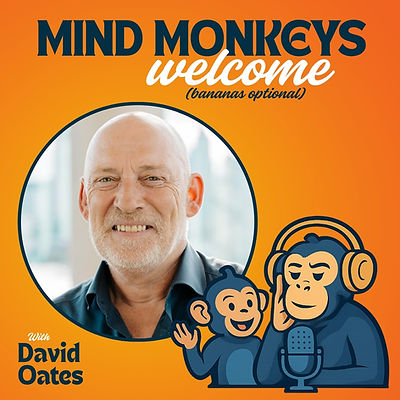
About Dave
Dave Oates is the Chief Alliances Officer for Yavica, an ERP software business focused on the Real Estate industry.
He has had a 42 year career in the software industry and has spent the last 30 years in senior sales and marketing leadership positions, including CRO at Altus Group, Primavera, Proda and on the board of Coyote Software.
Dave has also held several Non-Executive positions across a number of organisations. Married with one son, one stepdaughter and three grandchildren, he has a passion for diversity.
Dave is also a singer and rhythm guitarist in the Oxfordshire blues band, The Vodka Shots.
Website: www.yavica.com
LinkedIn: www.linkedin.com/in/dpoates/
Enjoyed the show?
Subscribe to "Mind Monkeys Welcome..." wherever you listen:
Spotify | Apple Podcasts | YouTube
Or take the Business Bravery Quiz to discover which of the Four Fears® is holding your business back most right now.

Show transcript
Follow the whole episode word-for-word:
MARK Thank you for joining us on Mind Monkey's Welcome, Bananas Optional, our regular opportunity to pause, rename, explain and reframe the most common hesitations that get in the way of the successes that we deserve. I'm Mark Franklin, I am your guide as we embark on raw, honest, irreverent and important conversations designed to acknowledge and normalise the fears we each face at work and at play. In order to help you, our amazing listener, reframe the perspectives around the stories that you've created for yourself, perhaps have been feeding those monkeys. I have a fabulous guest today and a very dear friend, Mr Dave Oates. Dave is Chief Alliances Officer for Yavica, which is an ERP software business focused within the real estate industry. He has a 40 plus year career in the software industry, won't thank me for saying that, and has spent the last 30 years in senior sales and marketing leadership positions, including CRO at the Altus Group, Primavera, Proda and on the board of Coyote Software. He's also held several non-exec positions across a number of organisations. His passion within the work he does centres around diversity and just a little bit about Dave, away from work he's married with one son, one stepdaughter, three grandchildren and he happens to be a bit of a tasty blues singer and one of the local Oxfordshire blues groups, the very well-renowned Vodka Shots. But enough about me talking about him, let's bring him on screen. Dave, how you doing? DAVE Hey Mark, nice to see you and thanks for having me on mate. MARK It's an absolute pleasure and you are all the way down in South Africa, so even though you look very local to me, you're tuning in from quite a distance. DAVE I am, I'm on holiday with the family, my wife and stepdaughter are South African, they've been down here a few weeks, and I've come down for the last two weeks to hang out and go on safari and do all that stuff. MARK Amazing, well I very much appreciate you setting aside the time to share this show with me today. So Dave, as you know the whole premise of this show is to sort of think about the fears that are getting our way, so it could be the fears of going the way of your own story or the fears that your clients, the people that you serve, sort of encounter and how you help to help them move past that. So I'm going to start with the question I ask everybody, how does fear show up for you? DAVE That's a great opening question, obviously I've heard it on your other podcast, but fear for me has always come out in the form of kind of imposter syndrome, which through therapy and all sorts of stuff, I've discovered it comes from my dad, but I never ever quite felt like I was in the right place. I never felt like I was quite good enough to be where I was and somehow I'd climbed the greasy pole, got, you know, I've had some senior positions, but it was always like yeah I shouldn't really be here, I'm sure there's somebody better at this. And that's actually quite a battle and that can get in the way a lot, because you always tend to, I find that I'm second-guessing myself quite a lot, you know, is this the right thing, just what John would do, is this what Mary would do, and I have to force myself to just like go with my gut and get on with it. But yeah, it's been a challenge throughout my career. A challenge. MARK Thank you so much for sharing that, I mean it's an incredibly honest response to our first question, so I really appreciate it. A challenge though that, you know, I made the because, you know, obviously you started when you were 10, maybe five, but you have outwardly achieved a huge amount and been incredibly successful. We've joked many times about the fact that there should be seats reserved for us in the BA Executive Club lounge, because we're always just sitting around and, you know, we're these, you know, back in my corporate days, living this super glamorous lifestyle of the kind that, you know, the champagne and the treats before you get on the plane and turn left if you're lucky. So, there is evidence within that 40 years that you clearly are good enough. How, other than just ploughing on, regardless, what has been that motivation for you to downplay that noise? DAVE Well, I think there's a couple of things. I've always been in sales and marketing positions. I mean, even now I'm running our alliances programme at Yavica. I was Chief Revenue Officer and we split the role, but it's always been a sales-driven role. The thing about a sales-driven role is every first day of the new financial year, you are nothing, because you're literally on zero. Yeah. So, for me, the motivation has always been the number. You know, you have to hit the number. So one of the ways I can get over my imposter syndrome is go, OK, well, if I'm ahead of the number, then I'm not sure I'm doing it right, but I must be doing something right. MARK Yeah. DAVE And when you are ahead of the number, the world, you can take a breath. You can calm down. So I think, you know, having that single goal and it's that single goal, which is not actually me, because I get more pleasure out of seeing a customer successful, seeing one of my team succeed, beat their number, get promoted, get married, have kids, whatever. And that's where I really get my good motivation. But my outward motivation to satisfy the noises in my head is to beat the number. And I've kind of done the same with marketing. You know, whenever I've been in, had marketing reporting to me, which is a few times now, again, I'll always have the metrics to measure. So if you have that imposter syndrome, which I know a lot of people do, you know, we all never quite feel good enough. And if we do, we're accused of being arrogant. So you can't really win. But I'll just use the metrics to be my bellwether, if you like. And it quietens the noise. MARK I'm glad you stepped back from the number once you kind of said, you know, that's the first thing. That's the kind of, nail the flag on the wall. If I beat the number, then I'm doing okay. But again, knowing as I do, I know the number isn't to be on end or to you. It's the number is, I guess, the proof of all those other things that do matter to you have worked. So let's explore those. Let's put down the number. Like you say, that's someone else's kind of measure of Dave's obviously up to the job. So we'll keep him on this year. And those are the things like you say, seeing your team succeed, seeing the transformation within your clients in terms of adopting the software that you have put in place for them. Tell me more about that. DAVE Let's take it into, let's take staff and clients as a different bucket. One of the things I'm most proud of in my career is I have a number of people trailing in my wake, a number of people that have worked for me, that have worked for me several times. That to me is affirmation that I'm a good guy to work for. I've said this for years, when people ask you that question, what would you like on your headstone? I just want to say he was a decent guy. That's all I want. Because I do, my personality is such that I desperately want people to like me. And that can be a that causes its own challenges. And I'll come back to that. But I love to see people succeed. I love to say, and this is only really true in sales, I guess, to have salespeople earning more than me, because in sales earnings is a metric. If I've got salespeople earning more than me as chief revenue officer, that means they're doing really, really well. They're smashing through their number, they're being successful. And, you know, the proudest moment, one of the proudest moments of my career was at the Altus Group, we went to a sales president's club. And president's club for those people aren't in the software industry is, end of the year, the most successful salespeople, plus some of the marketing team, plus some of the SEs, and so pre-sales guys, some of the admin, whoever's nominated, will go somewhere incredibly impressive. I've done Hawaii, I've done Singapore, I've done Cabo in Mexico, all sorts of places, staying in five-star hotels, American companies spare no expense on these things. The proudest moment of my life was, as I say, at Altus, I think we were in Cabo, and two of my salespeople got number one salesperson in the world and number two salesperson in the world. And that, for me, was an absolute mark of success. So that was one of those occasions I could look back and go, well, I must have something to do with it. Yes, they're great people, they're good salespeople, but I must have something to do with it. And I got a massive sense of pride by that. And actually, and that was 10 years ago, and I'm still in touch with them. In fact, one of them is still at Altus, and I speak to him, have lunch with him once every couple of months. That, to me, is a huge thing. The other thing that I'm really proud of is, I had a team, a company called Conga. I left the real estate tech industry for a while to go and get some SaaS experience, because real estate tech was really late in adopting SaaS. I was at a company called Conga, and my team, which grew to 60-odd people, when it was 60 people, 30% of those people were white and male. The rest were ethnically diverse, gender diverse. And that was one of the teams I was most proud of, because we deliberately set, well, not deliberately set out, we set, actually, we set out to do, for the first time ever, redacted CVs. So it didn't have your name, didn't have your gender, didn't have where you went to school, didn't have where you were born. And it meant that we were, that initial screening, we were getting candidates based on their skills, rather than anything else. Now, I know, and you know, this is something I'm really passionate about, Mark. People will say, we never judge CVs like that. You do subconsciously. Whether you say you're, if you're a racist or not a racist, you'll still judge somebody called Mark Franklin different to somebody called, I don't know, Ritsan Khan. It's just subconscious. So, by screening it, we ended up with this incredibly diverse team, which meant, from a business perspective, and this wasn't just about altruism, from a business perspective, any enquiry that came in, and I ran everything outside the Americas, any enquiry that came in, I had some, the chances I'd have somebody that would speak the language, understand the customs, understand the local business ways of doing things. So, from a business perspective, and this is the bit I don't get with why people don't adopt diversity more, it gave me an advantage. If I'm trying to do business in the UAE, and I've got three or two Emiratis on my team, which I did, I've got an advantage over a similar company based in the UK, or with their international operation in the UK, that have only got English speakers. So, there's a really good, humane, human reason for doing it, but there's actually a really good business reason for doing it. And as a result, we were really successful. That business was growing at like 90% a year for three years. MARK Yeah. DAVE And across the globe. MARK I mean, there's a lot within that to celebrate. What I would like to do, just to bring it back to you, if I may, because just touching on, again, that sort of honesty, sort of the hand up saying the imposter syndrome earlier on in the conversation, I'm wondering, I don't want to turn this into like a coaching session, but I'm wondering again, because what clearly brings you joy, because again, you can see it in your energy, you kind of lean into the screen, you started talking about this, about the teams, the diversity, seeing their success. It's not about the Mexicos, and the Hawaiis, and the gold watches, and all that kind of nonsense that comes with being in the club or whatever. Come back to imposter syndrome, because I'm going to make a sweeping generalisation because sales, like you say, the metric is the number, the number is all. But that's not the thing that drives you. It's the people that drive you. There's two things that come out of that, I think. One, the imposter syndrome rises because you are living in a world or operating in a world which is driven by something aside from what actually drives you. There is that kind of disconnect. Technically, I know you've made it work for you, because again, you focus on the people. But perhaps the flip side of that, one of the reasons why you don't need to have imposter syndrome, because you have been so successful, is you've almost kind of created that earning by stealth mentality of the numbers will follow if you have the right people. DAVE Yeah. That's, that's very observant. You're right. I absolutely believe that if you get, and it's not just the people, you need to get the processes right as well. MARK Yeah. DAVE But if you get the people and the processes right, I believe firmly that results will follow. I have a great friend who's a golf coach. And he talks about, and he plays in the Vodka Shots as well, actually, but he talks about trust the process, the results will come. And it's a great metric. It's a great saying. And I've tried to incorporate that into what I do. If you trust the people and you trust the process, everything else will flow. It's a bit like, I've always said to salespeople, don't worry about your bonus plan, your incentive plan. Don't worry about it. Get the basics right. Do the job properly. And sales is a hugely underplayed skills game. And I've been coaching this for years that everything in sales is taught. They talk about, are you a born salesman or a made salesperson? I think you're born with the personality to be able to go and talk to people, but then you'll give them the skills to do the job. But I've always said, if you get the process right, do the job properly, put the effort in, which is huge. Somebody once said to me, sales is 90% inspiration, sorry, 10% inspiration, 90% perspiration. Get all that right, everything else will follow. Now, yes, there's some other things, you've got to have the right product. I mean, nobody can sell something that doesn't work, but you've got to have the right product. Let's assume that's all in place. Get everything else right, and it'll come. I've always worked extremely hard. I like working. I enjoy it. I'm enjoying it less now I'm getting older, but I don't commute into London every day anymore. But I do work hard, but I also have worked hard over the years. Again, I think coming back to this imposter syndrome, I figured, right, I'm going to try harder than anybody else, because that's the one thing I can control. So if I try harder, then maybe I'm still not smart enough, as smart as other people, et cetera, et cetera, but I'll put more effort in, because I can't control my comparative intelligence. I think I'm pretty smart, but I'm not as smart as other people in the room, but I'll just control the level of effort. And that's what I've tried to do. MARK I'm wondering, because again, thinking about the results that you have created for all those companies that you've been a part of, the results that you've seen from the teams that you've built, supported, got out of the way of, how fair is it for me to say that that additional effort, again, still, you've applied yourself to the people in the process, as opposed to, again, I'm coming back to this idea of, it's not about the number. Because let's say, yeah, 42 years doing what you do at a very, very high standard in some serious companies at a serious level. There's a huge body of evidence there that proves that clearly you are more than capable. Clearly you are somebody who makes things happen. The numbers follow, the team follows, the businesses grow, the clients find success. Reflecting on that now, how do you connect to those truths, even in those moments of, I still worry if I'm not good enough? DAVE Okay. Badly, probably. I do look back on my career with some pride. There have been failures along the way. Nobody sticks around in the tech industry for 40-odd years without failing occasionally. That's fine. Failure is all part of the journey. I've been pretty good, apart from once, at seeing the writing on the wall and gone before it became an issue. I've learned from those failures, I think. But how do I connect the dots? I don't know, actually. Don't get me wrong, I don't always sit here thinking I'm a failure, or I'm not good enough. It's a thing that gets in the way every now and then. It's not a permanent state of mind. It's a bit like, I can watch the lead singer in your band, Nik, and think, I'm not that good. Because as a frontman he’s impeccable. We all know that. But then I get up on stage, and I think, yeah, I'm good at this. I'm always comparing myself. But I've had some big, big failures in my life. But I've dealt with them and moved on. If I look back on the original question, yeah, there are times I sit and reflect and go, this has gone okay, actually. I've got a nice house, I've got a beautiful family, I've got a nice car. I'm generally fairly relaxed. You know, I'm feeling pretty comfortable in my own skin. It's not a constant state of mind. It's just times when the blackness drops, which it does. Then I think, I'm not good enough for this. And it's because, and I'll share this, and I probably shouldn't, but I will. I went through therapy to figure some of this stuff out. And it was because my dad was so successful. My dad was like the hero in my life. Died 10 years ago. Actually, 10 years ago last week. From being little, my dad was my hero. He's the man that, I'm going to get a plug in for that. He invented Castrol GTX. He led the design team for Castrol GTX. And was born in the back streets of Salford, in a little place called Swinton. Outside toilet, getting on down the back of the house. The pictures you see at the start of Coronation Street. Dad died when he was 14. He left school at 14, went to work for the company that became Castrol, a company called Fletcher Miller, as an apprentice assistant tea boy in the lab. But the lowest of the low. Did a chemistry degree at night school. Ended up as a chemical engineer working for them. Ended up, then went on to lead, years later, leading the design team for GTX. Wrote a book about it, which, don't read it, it's all chemical formulas, you can't understand a word. And ended up running their international division. One career, one company's whole career. Very pragmatic, Northern got big, six foot three, ex-rugby league player. Very powerful, very dominant. One of those guys that would come in and just take over the room. And I wasn't scared of him. I had no reason to be scared of him, but I was always in awe of him. And when I went through some therapy over the years to get try and figure this stuff out, which I'm not ashamed to admit, because I think everybody should do it at least once, it's really good for you. I came to the conclusion that I'm just trying to emulate my dad. But in my seven-year-old brain, 10-year-old brain, whatever, I can never be as successful as my dad. And that's what's kind of driven some of this thought process. So I don't feel like that all the time. It's just when I get a bit down and I start reflecting. But I've taken some other steps personally to kind of offset that. So, I now meditate quite a lot. I make sure I get reflective time every day. I pray to a higher power, not God, because I don't believe in God, but I know there's something bigger than me in the universe. And that gives me a sense of calm, which when my brain, my washing machine head is on tumble, is on spin, it gives me a way of clearing my head and getting out of it. And that I've found incredibly useful, particularly as I've got older. Because as you get older, there's more crap in your head, right? There just is. Back to life. So I've found mechanisms to help me cope with it. And it's even now, if I'm having a bad day at work, I will take myself out of the office for 10 minutes, tell everybody I'm going for a smoke and just go, actually we work in Grosvenor Street in London, Grosvenor Square, it's just been reopened. I can go and sit in my office and clear my head. I wish I'd learned that 20 years ago. It would have made my life a lot more bearable for a lot of it, if I'd had that mechanism and that tool. MARK Do you think, again, I'm very mindful that I don't want to turn this into a public therapy session. DAVE Oh, you're the one who did. MARK Coming back to the imposter syndrome, I mean, again, listening to what you said about your dad, you know, I'm very similar, as you know, my dad passed away just over a year ago. I held him to that incredible high esteem because in my eyes, he did all the things that a successful man does. So you kind of follow in those footsteps. And there are times within that journey, you're following in the footsteps of your dad, you're following in someone else's footsteps, again, coming back to the imposter syndrome, that you are forgetting to walk in your own footsteps, you're forgetting your own story. And so whilst you hold on to that person, and you think, I can never be like them, the truth of the matter is, that's a good thing, because you need to be you. Agreed. And I'm sure, I mean, you know, tell me if I'm wrong, but your dad would have seen quite a considerable amount of your journey. I'm sure he was he was very proud seeing what you were doing. DAVE Interesting. So, yes, he was, but he was one of those typical old northern guys, because he'd have been 90 now. Anyway, it doesn't matter. It was not in his nature to tell me. So, when he died at his funeral, I had several of his very old friends come up to me and go, your dad was incredibly proud of you and what you achieved. I remember driving back from the funeral thinking, why the bloody hell didn't he tell me? Yeah, but it wasn't it's not it wasn't his nature. No, that's just not him. He was not an emotional person. The only person I ever saw him show real emotion to, apart from my mum, but was my son, because Ben was he wasn't his only grandson at that point, grandchild, but he was his first grandchild. And when he died, his others would have been still babies, I think, I think probably already got taken ill. He used to show that affection to Ben. If I had to watch it through the crack in the living room door, he wouldn't do it if anybody else was around. MARK Yeah. DAVE But if it was just him and Ben, when Ben was, you know, three, four, five, six, whatever, they would have a great time. Yeah, they'd be wrestling and fighting and, you know, doing all the things that grandpas do with their grandkids. But he wouldn't show it in front of anybody else. It was almost like a I think it's a northern armour thing. Yeah, it's up north, right? So don't show affection or emotion. So yeah, so he was I found out later he was incredibly proud of him. But I didn't find out from him. MARK And again, with all due respect to your dad, I mean, the way he was probably brought up and again, you know, what he considered to be, you know, what a man does. It wasn't he wasn't doing those things because he didn't feel them. Again, that's just how he dealt with it. DAVE And oh, 100 percent. I've never worried about the level of love or affection that my father had for me. You're right. It was just it was a generational thing. You've known me a long time. I'm very open. Yeah. My dad used to be horrified about how open I was. You do tell him that. Well, it's just how I'm feeling. Yeah. So, I kind of broke the cycle. My brother, interestingly, is exactly the same as my dad. Yeah, exactly the same. And I'm glad I'm not. And my mom always was, but didn't feel she was able to. So since my dad passed away, you know, God rest his soul. My mom's become a lot more open. My mom's told me she loves me and the grandkids, et cetera, more since he died than she's ever told anybody. Yeah. And it was 10 years ago. But it was just it was a, it was a generational trait. And if you look back at where we lived in the north, in the 60s, early 70s, with all the trials and tribulations going on in the world at the time. Men worked. Women run the home. End of. Yeah. End of. It was just how it was. And yeah, we can look back and criticise it, but it was just how it was. MARK And I think, again, the important thing to take from all this, and again, I say it with all due respect to your dad, like you say, that's how it was. That's how he was. That's that's his story, because that's the imposter syndrome and that I can't live up to that. And, you know, I'm frowned upon for being open and being more honest and perhaps more emotional, which is the truer version of you. That's the kind of tension, is it that like you say, that's when the black mood descends because you've got that inner conflict of here's my hero. That's everything that I've been brought up to believe is what success looks like, but actually everything within my fibre, my being isn't that. And then you get that that kind of that inner turmoil, like you say, the washing machine mind. MARK Well, you know, crikey, who am I? Yeah, hence imposter syndrome. But right now and again as you say we've been friends for a very long time and I I think it's fair to say that you are most definitely more Content at peace you are more connected to yourself now than ever is that is that a fair reflection? DAVE that's an absolutely fair reflection and Yeah, it's an absolutely fair reflection and there's been some reasons for that I was kind of hesitating as well as you go down this route, but I'm going to I'll be honest, but I gave up drinking a year again Some of the tensions in my life some of the mental battles I faced meant that I had a problem with alcohol so I took a decision a year and What day we are a? year and 15 days ago, I Took a decision to stop drinking And I have learned so much about myself in that period of time with help. I've had some fantastic support networks But I Realised that I've realised sorry I've realised over time since I stopped drinking that I was Drink was never my problem Drink was a really bad solution to my problems And my problems were the imposter syndrome Some of the you know mental challenges of my relationship my dad Lots of other things and I would drink to suppress them and Once that got to the point where the drink was making me ill I thought okay. I've got to do something about this and I took the decision which you knew about at the time I told you straight away. To stop drinking and in that year I have learned a Level of serenity that I've never known. On top of that I married my current wife two years ago. She has brought I mean, she's Sophie's African. You all know her but Sophie's African She's the happiest luckiest smiliest person. I know A combination of those two things have brought a level of peace to my life that I've never had Yeah, and actually I am getting to the stage where I can just let stuff go now If stuff winds me up I can let it go Because You kind of realise it's not worth it life's too short Yeah, you've got to go and enjoy yourself and you know, I've always enjoyed myself, but I've always enjoyed myself with a drink command now I've learned to enjoy myself without a drink command and I've learned that Well, I've learned so much mark as you know, but things like I've learned where my real friends are I've learned where the real good things in my life are What are the things that give me true joy The time I spend my grandchildren is now quality time Yeah, you know, it's not oh, let's stop and have a pint on the way. It's what do you want to do kids? I Spent and I'm gonna give a quick advert. Actually. I spend more time in the Shake Shack, the Shake Shop in Whitney Than I do in the pub Because when I'm with the kids, I'll go to shake now two years ago No kids you can get a pudding in the tavern, yeah, we'll go for a pint So I'm learning simple things again I'm getting more joy out of my music than I ever did Even though the first time I played it I realised After I stopped drinking, I've never played a gig completely sober in my life And the first one was a bit terrifying but after that I get more joy out of it You know, I get more joy out of listening to music I get more joy of reading books I get more joy. I'm watching movies. It's it's weird. It's weird. It's a whole new world You know, it's like Getting a bit personal I was at one of your gigs a couple of weeks ago and I hang out hung out with your wife for the night and Hanna and I had a scream absolute riot and I was stone-cold sober So it's taught me to enjoy life again, I I'm glad I'm wearing glasses. MARK I'm getting a little bit emotionally for you mate. Um, because I mean, it's unbelievably generous for you to share this And I thoroughly appreciate you doing so also again, just to share my my admiration and my pride in you because Like I say I've I've known you a long time. I Thought I knew you I certainly liked the day that I knew the day that is now in front of us Oh as your kind of friends and your peers is Is is the is the real Dave? You know, it's this it's this it's much happier much more centred much more grounded much more just Honest with himself and I'm hoping again That those other noises again the imposter syndrome all those kind of things that comparison itis that's going on as you Go beyond that first year and grow even more comfortable in this kind of the real skin of Dave as opposed to you know, um, But did it becomes easiest to let go that looking sideways and actually lean into the I've done really well now. DAVE Look at me Mm-hmm Well, well, I think the thing for me is This is where I think the timings perfect. I've given myself a four to five year horizon before I Retire, I won't retire completely I get bored but before I stop doing the corporate gig and Going to my plan is I want to go and do some more non-exec work because I really enjoy us particularly enjoy the non-exec work partly because you're advising rather than being governed by number so it's It's less stress But my goal is four to five years back away from the Five-day week and flip my working life to a two-day working week in a five-day weekend That's my goal and to be able to just enjoy my Twilight years, I think I've got a few years left in me yet, but and I think You know, I think prior to the last year 18 months I would have panicked about that How am I gonna cope with that if I can't prove myself all the time? How am I gonna cope? If I'm not driven by a number, how will I cope? Yeah Actually, I'm now in the stage, but I can't wait I'm really looking forward to it. And if I could I'd go tomorrow. I just can't physically afford to go tomorrow So the objective is to try and make sure over the next four or five years I can Stack the pension up more and and be in a position I can call it a day But I'm really looking forward to and I really would love to do something like you do now, I'm not I've not got the marketing background that you've got but the work you do with your clients is I think incredible because it's about Giving them the opportunity To get out of their own way and be more successful there's um It's a great thing I'm bearing my I don't believe in God, but if you've what's the film with Steve Carell is Noah Oh, Evan almighty Evan almighty. Yeah, there's a great scene in that but I think people should go and watch and as you get into spiritualities, which I am doing now it is quite important, but Steve Carell's wife Evan's wife is in a restaurant or a bar and God Morgan Freeman appears to her as a waiter yeah, and she starts talking about this arc and you know, God should tell him what to do and she said and God says Do you think God would go and tell him what? Sorry, if you said to me, I want him. I want God to make him brave Do you think God would make him brave or do you think you'd give him the opportunity to be brave and That's what I'm looking for in my spiritual journey at the moment is give me the opportunity to be the best person I can be Give me the opportunity to help others Give me the opportunity to pay the 40-plus year career, which you keep bloody referring to As an aside I used to be called the godfather of prop tech which is property technology Yeah, and then somebody changed it to the grandfather of prop tech so I've tried to kill it now So when they start on your great-grandfather you really got cracking heads, yeah But if I can be given the opportunity to pay that 40 years 40 plus years of experience forward Which is why I think an NED career an advisory career would would suit me and That's that's what I want. I want to give something back now I'm gonna Sorry, there's one thing. I want to just bring in here Mark when I met briefly So I'm a coffee and talk about putting this together. MARK Yeah DAVE There's a phrase that I've learned which really applies to me and I think could maybe help other people as well one of the things that I Have been in the past is self-centred Want to be the centre of attention etc, etc, maybe coming over my imposter syndrome, whatever it might be there's lots of reason I'm sure but There's a phrase I've learned which I'm trying to apply. I'm not doing a great job yet, but I'm trying to apply Which is don't think of you don't think less of yourself Think of yourself less In other words stop beating yourself up pay it forward I Go think of other people first and that is something I've learned that in the last Three months two months. Yeah, I'm trying every day to apply that MARK Well, I'm gonna I'm gonna round things up with an observation if I may in too much as again Thinking about as you say your career has been driven by a number, but you've never been driven by the number You've been driven by the people You said a minute ago Yeah, you haven't got the marketing background that I have and so on so forth, but I would challenge that because again You've existed in a world that is is stories and it is Celebrating others and I'm I suppose the point I want to finish on is whilst the imposter syndrome the comparison is is bought Brought out of a lifetime of looking sideways And the tension it has existed because that was pulling you away from who you wanted to be You have been doing those things all along you have lift others up Yeah you have had successful teams who've wanted to follow you because of the example you've set and now in this sort of past year 18 months with the clarity with the serenity with the kind of Incredibly powerful steps that you have taken on your own terms. Yeah, you took that brave decision It's only going to become easier for you to lean into the true Dave who's been there all along I would say and has been doing marvellous things I just think now perhaps you're noticing it more Yeah, you're probably right. Thank you for that. Yeah, so that that's my thought for the day. But again, Dave I mean as you say we met a couple weeks ago just to talk about you what this might go like and I'll be honest I never plan these shows. They're always very kind of organic and we just chat where we chat and I'm so incredibly grateful for you to have shared your story with such honesty and vulnerability because you're absolutely right – hopefully someone out there will hear that thing. Oh my god, that's me I can see that now because That's what that's what we can hope wasn't like so we just normally we talk about these things in a way that other people just feel slightly more comfortable to think. Okay, I see it Maybe I can do that take that first step and do something about it DAVE If if that's what comes out of it Mark, I’ll be delighted man MARK Yeah, well, I think you've gone above and beyond to try and help make that happen. So again, thank you Dave, where can people find you get in touch with you? Message you thank you or whatever They can obviously on LinkedIn. DAVE Uh, it's David Oates on LinkedIn. Um And all the usual social media channels. I'm on Facebook as David Oates – I am old so I still use Facebook. Um Instagram all the usual things or you can absolutely reach out to me at Yavica. Um david.oates at yavica.com I'm happy to talk to anybody. MARK Amazing and from a musical point of view because we're both we're both playing um At Minster Festival, Minster Lovell. So anyone sort of Oxfordshire, West Oxfordshire way if they fancy coming to See the amazing Vodka Shots DAVE Uh The amazing Britpop Nation, MARK Yep, can we find this that's Bank Holiday Sunday in August isn't it? DAVE Yeah, we're on at four and I think you're on at 10, right? MARK Something like that. Yeah. DAVE Yeah It'll be a fantastic day. MARK It always is It always is and it's always a pleasure to to see you up there because I think on stage. I think that's again. That's, that's the Dave. DAVE Yeah MARK And plus we all get to take the micky out of you you're love of Springsteen which we never got into and I think that's a good thing we didn't know because that would just yeah end in disaster So let's not do that DAVE Yeah, yeah the world does not need to hear that MARK No, cool, my friend. Thank you again so much. And thank you to everybody who tuned in there's been some lovely, uh comments Uh in the chat, so I know we had people listening and hopefully taking a lot from this Dave. You take care mate. I will see you safe journey back Um, see you at Minster and again. Thank you everybody DAVE Cheers buddy, um MARK See you all soon. Uh next episode Oh, it's it's a big one. I think it's something like Friday the 4th of September with the unbelievable master coach Angela Cox. Um, so hopefully see you all online for that one as well. Cheers. Dave Thank you everyone. Bye